
Jev Engineering, Explained for Product Managers
What it is, how it works, and why it changes the way you should think about AI features.
This post is based on the article "Jev Engineering: What Happens When the LLM Stops Making Every Decision". Jev is a very new idea, so treat the details as early.
The short version
Most people think of AI as a chatbot: you type, a language model replies. But when a company builds an AI agent, something that takes actions, uses tools and works towards a goal, the model has to make many small decisions along the way. Which tool should I use? Is this source good enough? Am I done yet? Is this action safe?
Today we usually let the same big language model (LLM) answer all of those questions in free-form text, and then write code to figure out what it meant. Jev Engineering is the idea of adding a dedicated decision layer around the LLM. The LLM still does the open-ended thinking and writing. Jev handles the small, bounded decisions and returns clean answers that software can use directly, often with a confidence score attached.
One-line definition: Jev Engineering is designing AI systems so the LLM does the creative work, a decision model makes structured choices with confidence scores, and normal application code keeps control of rules and permissions.
First, a chatbot is not the whole AI product
A chatbot answers a message. An agent is different: it runs in a loop. It looks at the situation, decides what to do, does it, then looks again. Think of a customer-support agent handling a failed payment. The model might write, "This seems to be a payment issue and should probably be sent to billing." That is a fine sentence, but your software cannot act on a sentence. Someone has to extract the department, the urgency, and whether human review is needed. That extra parsing step is where things get messy and unreliable.
The hidden decision layer inside every agent
Take a research agent that investigates a topic and writes a report. The LLM plans, searches and writes. But around that work, the system keeps making decisions: which worker should act next, is this source useful, is the task finished?

Jev organises these into three simple decision types:
Decision type | What it does | Example |
Choice | Picks one option from a fixed list | Next worker: search, read, analyze or write |
Score | Rates something on an ordered scale, such as 1 to 5 | How useful is this source? |
Noul | A yes/no question answered as a probability from 0 to 1 | Is the task finished? (0.85 means probably yes) |
The important part: these decisions are all made against the same "state" (the task, the evidence collected so far, past actions and available workers). The output is a neat value your code can read, not a paragraph it has to interpret.
A division of labor, not a new brain
Jev is not meant to replace the LLM. It's a split of responsibilities:
The LLM plans, reasons and proposes an action.
Jev makes bounded decisions: routes to the right tool, judges risk, scores options, checks against criteria.
Application code enforces policies and permissions, runs the approved action and handles side effects.

An analogy: the LLM is a smart analyst who drafts a recommendation. Jev is the reviewer who asks, "How risky is this? Does it need sign-off?" Your application code is the system that actually holds the keys and decides what is allowed.
A concrete example: should the agent run this command?
Picture a coding agent. The app hands Jev the task, the files changed, the test results, the environment and the proposed command, then asks two questions in advance:
Risk (a Score): low means read-only or easy to undo, medium means it changes local state, high means destructive or with external consequences.
Needs review? (a Noul): "Should a human review this action first?"
Then plain code applies the rule. If risk is high, send it to a review queue. If the review probability is above 0.80, also review. Otherwise, run it. The key idea is that the application defines the possible decisions before the model runs, and normal code decides what each decision allows.
Caution: a structured output can still be wrong. A valid answer is not the same as a correct answer, so permissions and side effects must stay under your application's control.
Confidence changes what the agent does next
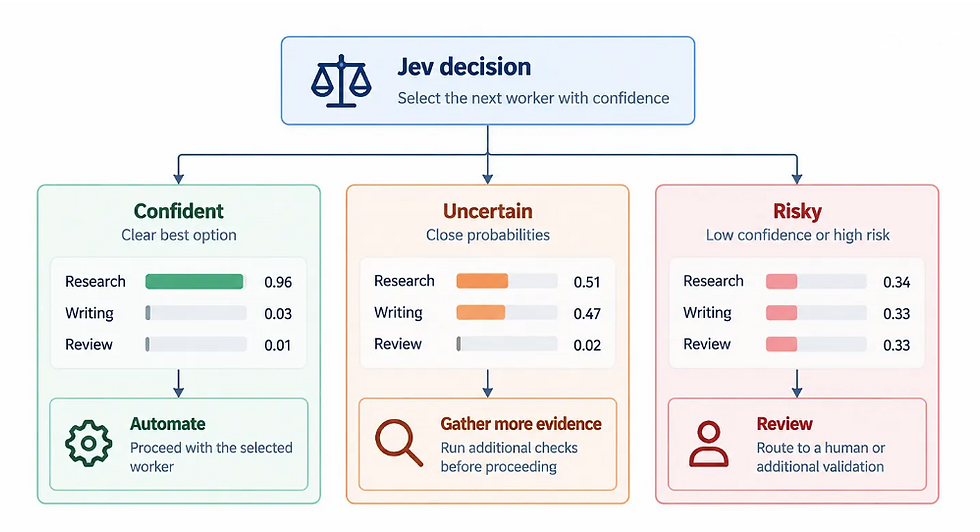
Because Jev returns probabilities, you can see how sure it is. Compare Research 0.51 / Writing 0.47 / Review 0.02 (a near tie) with Research 0.96 / Writing 0.03 / Review 0.01 (a clear winner). Those are very different situations, and the product can respond differently:
Confident: automate and proceed.
Uncertain: gather more evidence first.
Risky (low confidence or high stakes): send to a human or extra validation.
The thresholds are application policy, meaning a low-stakes decision can tolerate more uncertainty than one that triggers something in the outside world.
Where this is already showing up
Model routing: send easy requests to a faster model and ambiguous ones to a more capable model.
Tool guarding: check a risky tool call before it executes.
Verification: judge a fuzzy condition that is hard to write as a normal test.
Agent loop control: decide whether to continue, retry, ask the user, or stop.
Integrations with LangChain (model routing and tool-risk middleware), Vercel's AI Gateway (choosing the next tool or subagent, continue/retry/stop decisions), and cites TypeSafe as positioning Jev around calibrated, probability-backed decisions. It also raises agent evaluation as an important test area, where judgments can be paired with deterministic checks.
Why should a Product Manager care?
You will not write this code, but Jev-style design turns AI behavior into things you can see, tune and own.
1. It makes AI behavior product policy, not a black box
Thresholds like "auto-approve above 0.9, ask a human between 0.6 and 0.9" are product decisions about risk and user trust. That is your territory, and it is easier to discuss than "the prompt seems to work."
2. It helps you balance cost, speed and quality
Routing simple requests to cheaper, faster models and hard ones to stronger models directly affects unit economics and latency. A decision layer is the mechanism that makes this possible.
3. It gives you safer automation
You can define which actions are always automatic, which need human approval, and which are blocked. For features touching payments, data deletion, emails to customers or production systems, this is what makes launching realistic.
4. It makes quality measurable
Structured outputs (a risk score, a probability, a chosen option) can be logged and tracked. You can measure how often the agent is confident, how often it escalates, and how often humans overrule it.
5. It shapes UX
Uncertainty is a design input. When confidence is low, should the product ask the user a clarifying question, show a preview, or offer an undo? The decision layer gives you the moment to design those flows.
A PM example (my illustration)
Imagine a refund assistant in a subscription product. The LLM reads the customer's message and drafts a reply. The decision layer scores the request: Is the customer eligible? Is fraud likely? Should a human approve? Your rules then say: eligible and low risk goes to automatic refund; borderline goes to a support agent; high fraud risk is declined with an escalation. You decide the thresholds together with finance and support, and you track refund accuracy and escalation rate as product metrics.
Questions to ask your engineering team
Which decisions in our agent are currently buried in free-text LLM output?
Which actions have real-world side effects, and who controls them?
What confidence thresholds do we use, and who owns them?
What happens on low confidence: retry, ask the user, or escalate?
How do we test and monitor these decisions once they are live?
Keep expectations realistic
Jev is early, its results are not proven at scale, and a structured answer can still be wrong. Its bigger point is that AI agents may be built from several specialized components (an LLM for open-ended work, a decision model for bounded judgments, and application code for control) rather than one giant model doing everything.
Takeaways
Jev Engineering means adding a decision layer that turns AI judgments into structured, confidence-scored outputs.
The LLM thinks and writes; Jev decides; your code enforces the rules.
Choice, Score and Noul (yes/no probability) are the three building blocks.
For PMs, it turns AI behavior into levers you can set, measure and explain: risk, cost, autonomy and user trust.


Comments